KOTA KINABALU: The Sabah Economic Development and Investment Authority (SEDIA) has completed nine Master Plan and Feasibility Study reports to guide the planning and implementation of the 13th Malaysia Plan (13MP) from 2026 – 2030.
Chief Minister Datuk Seri Panglima Haji Hajiji Haji Noor, who is also SEDIA Chairman said these plans were prepared to continue development programmes and projects in lagging regions.
This include the Sabah Border Economic Development Study, which proposed four catalytic projects and 27 additional projects.
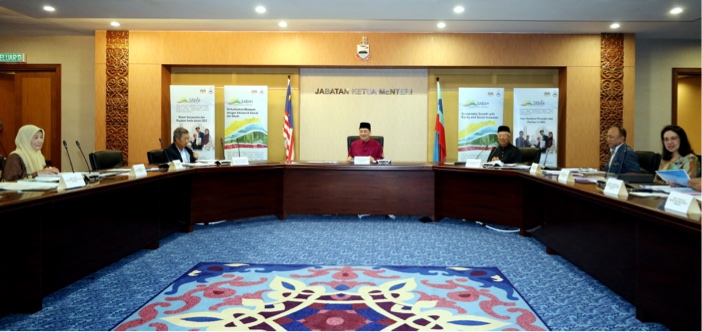
Another study is the Sabah Interior Food Valley Master Plan, covering five main districts – Keningau, Tambunan, Tenom, Tongod and Nabawan involving a land area of 2.3 million hectares, he said when chairing the SEDIA meeting at Menara Kinabalu today.
Hajiji said SEDIA has received a total allocation of RM3.7 billion from the Federal Government since its establishment up to the 12MP.
“The Federal Government, especially the Ministry of Economy, has approved an allocation of RM646.3 million to Sedia in the 12MP. This brings the total to RM3.7 billion since Sedia’s establishment, beginning from the 9MP,” he said.
Hajiji welcomed the Federal Government’s continued commitment under the 13MP to enhance balanced progress and development in less developed regions.
“Corridor development and specialised production hubs will continue to be explored to harness the economic potential of local areas,” he said.
Based on the “Outcome Achievement Report of Sabah Development Corridor (SDC) Projects under the 9th to the 11th Malaysia Plans” Report, which summarises the outcomes of key development projects implemented under the Sabah Development Corridor (SDC), SEDIA has recorded commendable achievements, he said.
Among them, in the agriculture and livestock sector, the development of the Keningau Integrated Livestock Centre (KILC), worth RM64.1 million had achieved an average daily milk production of 7,168 litres or 2.5 million litres annually, he said.
He added that the project contributed 29.6 per cent of Sabah’s total milk production in 2022 and created 78 jobs as of 2024.
In the Industrial and Logistics sector, Hajiji said the Palm Oil Industrial Cluster (POIC Lahad Datu), worth RM932 million and developed to accelerate downstream palm oil industry development, has generated RM4.1 billion in investments and created 3,099 job opportunities as of 2024, with 42 companies currently operating.
Meanwhile, in the infrastructure and connectivity sector, among the key outcomes are the 16.1-kilometre pedestrian and cycling pathway from Tanjung Aru to UMS, which has enhanced Kota Kinabalu City’s liveability, and the dual-carriageway road from UiTM to the Sepangar Bay Container Port spanning 3 kilometres, including a 600-metre tunnel serving as an alternative route that has reduced travel time and distance.
As a result of this project, the total investments in KKIP increased to RM8.32 billion (2017–2024) and created 5,882 job opportunities, he said.
Meanwhile, the construction of the 48.5-kilometre Tongod–Pinangah road at a cost of RM76.8 million has reduced travel time by up to 75 per cent, from four hours to one hour, he said.
Hajiji said SEDIA has also established the Sandakan Education Hub, worth RM100 million, as a Human Capital Development Model Cluster involving four institutions – the Faculty of Sustainable Agriculture, UMS; Sandakan Polytechnic; MARA Junior Science College (MRSM) Sandakan; and Sandakan Vocational College 2.
He said SEDIA has been mandated to implement Madani initiatives involving 1,230 projects under 12MP worth RM102.3 million, including poverty eradication, people- centric programmes, the People’s Facilities Initiative (IKR), and the People’s Income Initiative (IPR).
“SEDIA’s track record in implementing projects successfully from the 9MP to the 12MP proves that the authority is an agency capable of accelerating implementation processes and conducting impact assessments in Sabah, a strategic and high-potential state,” he said.
Hajiji said that nation-building can enjoy harmony only if development between less developed and rapidly developing regions is balanced.
“This gap must be narrowed to prevent regions from being left behind. If necessary, ‘catching up strategies’ or shortcut approaches can be applied through policy restructuring and decisive action.
“The focus should not be overly centred on immediate Return on Investment (ROI), but every cent spent will yield returns to the government through tax collection. All parties will benefit and ultimately contribute to the national treasury, in addition to creating social impacts such as employment and small businesses,” he added.-pr/BNN