TONGOD: The State Government continues to focus on the development of rural areas through the Sabah Maju Jaya (SMJ) development plan, including ensuring that Tongod is not left behind in the state’s progress.
Chief Minister Datuk Seri Panglima Haji Hajiji Haji Noor said that from last year until mid- this year, Tongod recorded significant progress in infrastructure development ranging from road connectivity, the economy, education and sustainable tourism potential.
He said the government remains committed to strengthening road networks linking Tongod with surrounding districts such as Keningau, Telupid, Sandakan and Tawau to improve mobility for the people and stimulate downstream economic growth in the area.
“Tongod has vast land areas with strong potential for modern agricultural development. The State Government is also providing various incentives to help transform subsistence farming into commercial agriculture capable of increasing household incomes,” he said.
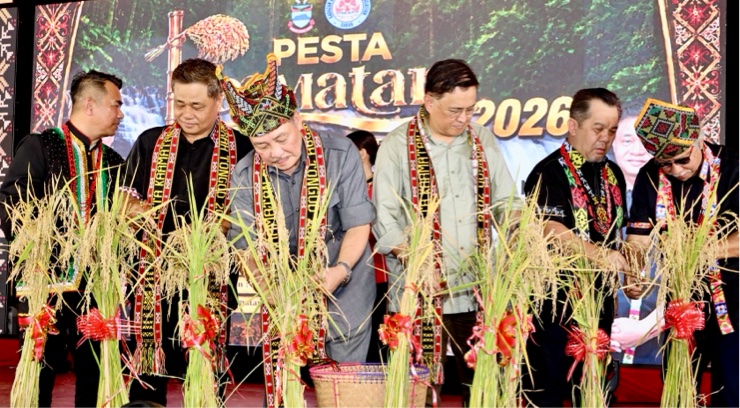
He said this when officiating at the Tongod District Level Kaamatan Festival 2026 at the Dewan Terbuka Dataran Rakyat Tongod on Wednesday.
Hajiji said the State Government is also paying serious attention to human capital development, particularly among the younger generation in rural areas, through major investments in education and skills training.
“We want the youths in Tongod to seize opportunities to further their studies, including in technical and skills-based fields, because they are the future leaders of this state,” he said.
He said Tongod also possesses highly valuable natural treasures, including the Imbak Canyon Conservation Area, which has great potential to be developed as Sabah’s sustainable eco-tourism hub.
According to him, Tongod’s location at the heart of Sabah’s geography makes the district “The Heart of Sabah”, connecting the northern, southern, eastern and western regions of the state.
He said the development of Tongod’s tourism sector must also move in tandem with efforts to preserve the authenticity of local cultures, including empowering handicraft products, traditional food and homestay programmes managed by local communities.
“Harmony between development and environmental conservation is the key to Tongod’s long-term economic sustainability,” he said.
Meanwhile, commenting on the water supply issues faced by Tongod residents, Hajiji said the problem would be addressed using allocations channelled by the Ministry of Rural and Regional Development (KKDW) to the State Government for the implementation of Rural Water Supply (BALB) projects.
He said the authority to implement the projects has now been delegated to the State Government, with more than RM4 billion allocated by KKDW this year for the purpose.
“Last April, the Federal Government through the Ministry of Rural and Regional Development handed over the authority to the State Government to implement water supply projects with an allocation exceeding RM4 billion, and I hope Tongod district will also benefit.
“This is what we have always discussed with the Federal Government. If we engage in discussions prudently and with mutual respect, many matters previously managed by the Federal Government or its departments in Sabah can now be entrusted to the state.
Over the past five years under the Gabungan Rakyat Sabah (GRS) government that I lead, many powers have already been devolved to the state, including rural water supply projects in Tongod,” he said.
Hajiji stressed that the spirit of cooperation between the state and Federal governments must continue without sidelining Sabah’s interests,while at the same time safeguarding the interests of Malaysia as a nation.
“We should not strain relations with the Federal Government simply because we are demanding the state’s rights. Instead, we must also work together to develop our country, Malaysia.
“Sabah is one of the states that formed Malaysia, therefore whatever we do must be done together so Sabah can continue progressing with the cooperation of the Federal Government.
“This is what we need to do. We should not quarrel with the Federal Government because Sabah still needs Federal assistance to continue developing,” he said.
He added that although Sabah’s revenue allocation may increase in the future, including through the 40 per cent special grant payment, the state still requires Federal cooperation to continue becoming a developed state within Malaysia.
On the Kaamatan celebration, Hajiji stressed that the festival not only symbolises gratitude for a bountiful harvest, but also serves as an important platform to strengthen unity and harmony among Sabah’s multi-racial communities in line with the theme “Harvesting Unity, Celebrating Harmony.”
Meanwhile, when asked by reporters about the proposal to build a new Tongod township, the Chief Minister said the project would be implemented by a private company on its own land.
“A private company will develop the new Tongod township on its own land, including the construction of government offices.
Therefore, we welcome cooperation between the private sector and the government. With the support of the people’s representatives here, this effort is expected to be realised in the near future,” he said.
At the event, the Chief Minister also handed over 239 Native Title (NT) land grants covering a total area of 583.38 hectares (1,441.57 acres) to the people of Tongod.
Of the total, 199 grants involving 500.09 hectares (1,235.75 acres) were ordinary NT grants, while 40 draft PANTAS grants involving seven mukims covered 83.29 hectares (205.82 acres).-pr/BNN