KOTA KINABALU: The State Government has introduced and embraced a new paradigm through the Outcome-Based Integrity (OBI) aspiration as a formula for building a resilient and corruption-resistant administrative ecosystem.
Chief Minister Datuk Seri Panglima Haji Hajiji Haji Noor said the aspiration proves that outcome-based governance is the most effective formula for building an administrative ecosystem that is resilient and resistant to corruption.
“Through OBI, every Governance, Integrity and Anti-Corruption instrument must deliver tangible outcomes.
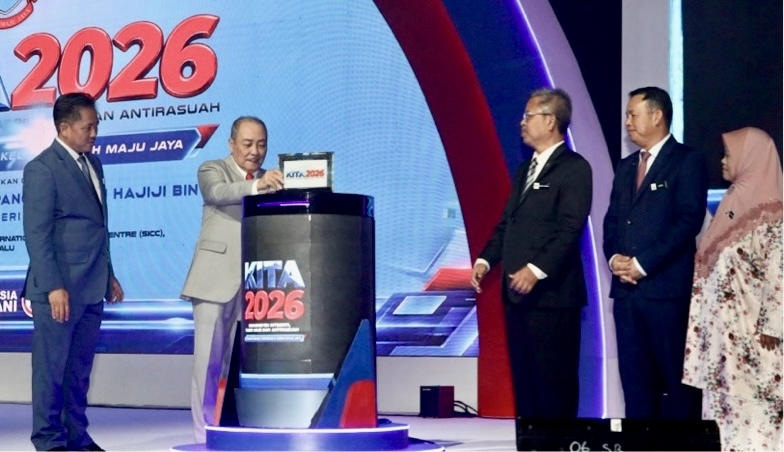
“OBI focuses on three main pillars, namely a significant reduction in the risks of fundamental leakages and misconduct; greater efficiency and transparency in public service delivery; and a significant increase in the level of public and investor confidence, as reflected in the Public Trust Index,” he said when officiating at the 2026 Integrity, Governance and Anti-Corruption Convention (KITA), themed “Integrity Driving Sabah Maju Jaya Governance”, at the Sabah International Convention Centre (SICC) here today.
He said governance must no longer be reactive, but instead be based on the 3P formula – Proactive, Predictive and Preventive by preventing problems before they occur through actual risk assessments.
“Disorganised bureaucracy is the most fertile breeding ground for corruption and ‘quick money’. Every ringgit of public funds spent must deliver maximum value for money directly towards the people’s well-being, without losing value along the way,” he said.
Hajiji said the State Government was committed to implementing three strategic pillars, including strengthening digitalisation, data analytics and behavioural insights through digital governance, predictive analytics and behavioural insights, as well as institutionalising OBI in agency performance assessments.
He said OBI outcome indicators would be incorporated into the annual Key Performance Indicators (KPIs) of all heads of departments and the leadership of State Government companies, while administrative performance would be measured according to the extent of reductions in leakage risks and improvements in service efficiency.
He said the State Government would also expand the empowerment of Certified Integrity Officers (CelOs) and strengthen the functions of Integrity Units to build a new generation of leaders with integrity.
Hajiji said integrity was not merely decorative rhetoric, but a fundamental pillar underpinning the success of the Sabah Maju Jaya (SMJ) Development Plan.
“Through strengthened Governance, Integrity and Anti-Corruption management driven by outcome-based initiatives, integrity is no longer merely a slogan or moral rhetoric, but a key pillar driving the success of the SMJ development plan.
“Integrity is the driving engine that ensures every public fund and every government policy delivers optimum returns and tangible impact to the people, without any leakage or misconduct,” he said.
He said a high level of integrity among civil servants was key to successfully implementing the SMJ 2.0 Development Plan (2026-2030), which identifies Integrity-Based Governance as one of its five main Strategic Enablers.
He said that in this new phase, service delivery would no longer be assessed merely through paper reports, but by tangible impacts on people’s well-being.
“I call on all civil servants to continue strengthening teamwork and upholding high standards of work ethics,” he said.
Hajiji said more than 2,500 participants from across the State attended the two-day KITA 2026, reflecting a collective determination and united commitment to strengthening Governance, Integrity and Anti-Corruption (GIA) management.
He said that since its inception in 2023 and continuation in the 2024 edition, KITA had proven its standing as a prestigious platform for Governance, Integrity and Anti-Corruption management, while laying the foundation for Sabah to become a pioneer, leader and benchmark in the field.
He added, among KITA’s achievements were the placement of 10 Certified Integrity Officers (CelOs) as heads of Integrity Units in every ministry, the development of the i-Adu mobile application, the i-DIMSS and i-STANS systems, as well as 17 Sabah State Government agency officers obtaining the Certification in Professional Integrity Assurance and Management (CPIAM) from Universiti Sains Malaysia.
“At the national level, the Sabah State Integrity and Governance Division (BIGONS) under the State Secretary’s Office also received UNGGUL recognition under the Integrity and Governance Management System (SPINE) certification by the Malaysian Institute of Integrity (IIM),” he said.-pr/BNN