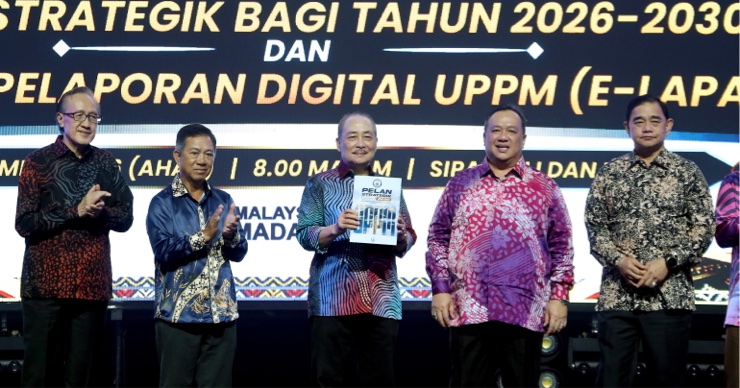
KOTA KINABALU: Community Development Leaders (PPM) and Pemaju Mukim must be more proactive in going to the ground, identifying the people’s needs and explaining government policies and achievements to ensure continued strong public support for the state administration.
Chief Minister Datuk Seri Panglima Haji Hajiji Haji Noor said the PPM and Pemaju Mukim were the backbone of the government at the grassroots level and carried a major responsibility in ensuring that government policies were effectively communicated and understood by the people.
He said they were also responsible for conveying the problems and needs of the community to elected representatives, ministers and government leaders so that appropriate action could be taken.
“The role of these community leaders is very important to me and the government. We must not only be trustworthy and possess high integrity but also extend our full cooperation to the elected representatives who have placed their trust in us.
“When we go to the ground, we must be good listeners and report the people’s problems to elected representatives, ministers and the Chief Minister,” he said in his speech at the Sabah Chief Minister’s Appreciation and Dinner with the Sabah Community Development Leaders Unit (UPPM) at the Sabah International Convention Centre (SICC) here on Sunday night.
Hajiji said PPM and Pemaju Mukim must also ensure that development requests and priorities in their respective areas were submitted through the proper channels and not referred to inappropriate parties.
He said he had found instances where applications were submitted by contractors when such matters should have been channelled through PPM, District Officers and elected representatives.
He wanted PPM and Pemaju Mukim to extend their full cooperation to the elected representatives who had entrusted them with responsibilities in their respective areas.
The Chief Minister also wanted them to explain the government’s achievements over the past five years, as well as programmes to be implemented over the next five years under the Sabah Maju Jaya (SMJ) 2.0 Development Roadmap.
He said the government had spent more than RM1.2 billion on educational assistance for Sabahans over the past five years, including more than RM600 million in scholarships and education loans benefiting over 16,000 students.
“Other assistance includes RM200 for every Form Five student before sitting for their examinations, involving approximately 35,000 to 40,000 students annually.
“The government also provides RM300 in assistance to Sabah students studying at public and private institutions of higher learning in the state to return home for Kaamatan, Hari Raya and Christmas celebrations, as well as an annual RM600 flight ticket subsidy for Sabah students studying in Peninsular Malaysia,” he said.
On welfare, he said about 140,000 eligible recipients received RM200 monthly through the SYUKUR initiative.
The government had also built more than 11,000 houses under the Rumah Mesra Sabah Maju Jaya (SMJ) programme.
On water supply, Hajiji said the government had spent more than RM1 billion on water treatment plant construction projects over the past five years.
Among them was the water treatment plant project in Tawau, which had achieved approximately 50 to 60 per cent physical progress through a soft loan of nearly RM400 million, while the Kogopon water treatment plant project in Papar, financed through a RM385 million soft loan, was expected to be completed within one to two months.
He said the State Government had also secured a RM300 million soft loan to increase the capacity of water treatment plants throughout Sabah, with several projects already completed and the remaining ones expected to be completed next year.
He said Sabah continued to face a non-revenue water (NRW) rate of about 60 per cent due to water theft and leaking pipes.
In this regard, RM100 million had been allocated to replace old and damaged pipes in several districts, including Kota Kinabalu, Ranau, Kudat and Pulau Banggi.
According to him, as a long-term solution, the government was implementing the Ulu Padas Dam project through a collaboration between Sabah Energy Corporation and private company Gamuda, which would provide not only electricity but also water supply for the next 50 to 60 years.
The project was expected to be completed in 2030 or 2031. Hajiji said PPM must also help explain issues concerning road development and public facilities based on facts, including distinguishing between the responsibilities of the State and Federal governments.
He said they must play their part in conveying accurate information to the people, particularly those who did not follow developments on social media, to prevent misunderstandings about the government’s efforts.-pr/BNN