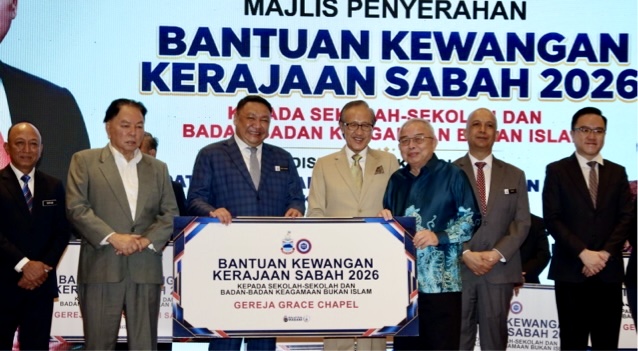
KOTA KINABALU: No school should be deprived of adequate educational infrastructure and no place of worship should be left out of government development assistance, in line with the State Government’s commitment to ensuring that aid is distributed fairly and equitably to all communities.
Chief Minister Datuk Seri Panglima Haji Hajiji Haji Noor said the State Government would continue to strengthen education, support community institutions, and ensure the state’s development benefits everyone, regardless of race or religion.
“Today’s Financial Assistance Presentation Ceremony for Schools and Non-Muslim Religious Bodies 2026 is not merely an annual event. It is a fundamental responsibility and a manifestation of the social justice that forms the cornerstone of the current State Government’s administration.
“We want to ensure that no school is deprived of adequate educational infrastructure and no place of worship is left behind in receiving development support from the government,” he said at the Financial Assistance Presentation Ceremony for Schools and Non-Muslim Religious Bodies at The Pacific Sutera Harbour Resort here today.
Deputy Chief Minister II cum Finance Minister Datuk Seri Panglima Masidi Manjun delivered the speech.
Hajiji said the State Government had increased the assistance allocation by RM20 million, from RM70 million in 2025 to RM90 million this year, reflecting its commitment to giving greater attention to the needs of schools and non-Muslim religious bodies throughout Sabah.
He said the increased allocation also reflected the government’s commitment to ensuring better access to education, while supporting building maintenance, learning activities and the operations of religious organisations for the benefit and comfort of their respective communities.
He said the Ministry of Finance had received 339 applications for assistance from schools this year, with total funding requests amounting to RM107.27 million across five eligible school categories.
Of these, RM40 million was approved for distribution to 320 schools that met the application requirements.
“Meanwhile, a total of 1,810 applications for assistance were received this year from Chinese temples, Hindu temples and churches of various denominations throughout Sabah, with funding requests amounting to RM235.30 million. Of this amount, RM50 million has been allocated to 1,761 non-Muslim religious bodies,” he said.
Hajiji said the government understood that grassroots needs far exceeded the available allocations.
However, assistance was provided based on priorities, needs and the government’s financial capacity to ensure that it reached those who required it.
“When the government’s financial position permits, we will continue striving to increase support and assistance for the people and institutions that play important roles in community development,” he said.
He said Sabah’s future strength depended on the quality of its younger generation, while the state’s various development plans required competitive, knowledgeable and skilled human capital.
He said education would remain one of the government’s priorities to ensure that Sabah’s children had better opportunities to learn, develop and achieve their aspirations.
“We do not want our children and the present generation to be mere spectators in the state’s development. We want them to become the generation that will lead and shape Sabah’s future,” he said.
According to him, the State Government’s recognition of the Unified Examination Certificate (UEC) has opened wider opportunities for certificate holders to pursue higher education at institutions owned by the Sabah State Government, as well as allowing them to apply for Sabah State Government scholarships.
He said the move reflected the government’s openness and confidence in the diverse education streams available in the state, with the aim of producing quality, knowledgeable and competitive human capital capable of contributing to Sabah’s development and progress.
Hajiji said the government would continue to safeguard the harmony that has been the strength of Sabah’s society, where racial, religious and cultural diversity is not a source of division but a driving force that strengthens unity.
He said the spirit of mutual respect and cooperation must continue to be preserved to ensure that Sabah remained a progressive, stable and harmonious state that provided opportunities for everyone.
He said the State Government would also continue striving to ensure that all communities, regardless of race, skin colour or religious beliefs, received fair and equitable treatment, while continuing to support institutions, non-governmental organisations (NGOs) and associations requiring assistance.
“The State Government will continue to strengthen education, support community institutions, preserve harmony and ensure that the state’s development benefits everyone,” he said.-pr/BNN