KOTA KINABALU: The State Government continues to intensify its digitalisation agenda as a key driver of growth, including expanding connectivity in rural areas, strengthening digital capabilitiesa nd accelerating the development of an inclusive digital economy.
Chief Minister Datuk Seri Panglima Haji Hajiji Haji Noor said for this purpose, a total of RM32.31 million has been allocated to the State Computer Services Department (JPKN) for operating and development expenditure this year.
He said of the total, RM9.59 million is to enhance the delivery of government services based on information and communication technology (ICT), covering the provision of computers and ICT networks to state government agencies, data centre management, strengthening cybersecurity, and the development of government application systems.
“The State Government, through the Sabah Maju Jaya (SMJ) development plan, with the support of the Ministry of Science, Technology and Innovation (KSTI), continues to place digitalisation as a core pillar of growth.
“Focus is given to expanding digital connectivity in rural areas, strengthening digital capabilities, and developing an inclusive digital economy, in line with the commitment to enhance the state’s productivity and competitiveness,” he said.
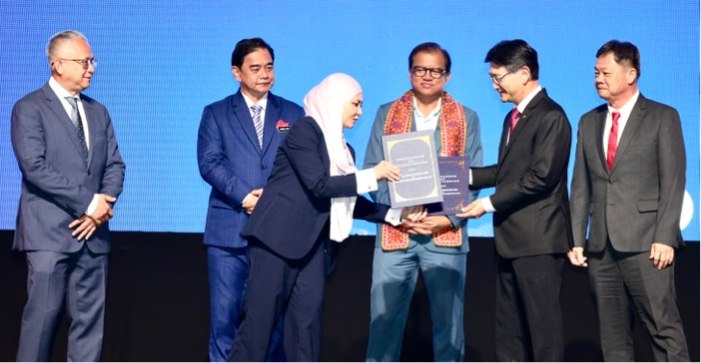
Hajiji said this at the launch of Celcom Timur (Sabah) Sdn Bhd’s new corporate identity at the Sabah International Convention Centre (SICC) here on Tuesday.
His speech was delivered by Assistant Minister to the Chief Minister, Datuk Joniston Bangkuai.
Hajiji said digital connectivity now plays a pivotal role in supporting communication, driving innovation, and unlocking growth opportunities across various sectors.
In this regard, he said strengthening digital infrastructure is among the critical factors in ensuring Sabah’s success and progress, including in realising the Sabah Maju Jaya (SMJ) 2.0 roadmap for the period 2026 to 2030.
“SMJ 2.0 is a key strategic plan designed to elevate Sabah’s competitiveness, productivity and economic value in a sustainable and inclusive manner.
“It is a continuation of SMJ 1.0, which previously focused on post-COVID-19 recovery and stabilisation, and is now expanded to address increasingly complex global challenges, including those driven by artificial intelligence (AI), the digital economy and cross-border trade,” he said.
He said in this context, close collaboration between the State Government and industry players such as Celcom Timur (Sabah) Sdn Bhd is crucial in bridging the digital divide and accelerating the development of the state’s digital ecosystem.
He added that the company’s corporate identity transformation reflects its readiness to move forward as an infrastructure provider and strategic partner in shaping Sabah’s digital future.
Hajiji said that to date, Celcom Timur Sabah has developed nearly 12,000 kilometres of fibre optic network across Sabah and the Federal Territory of Labuan, serving as the backbone of inter-district connectivity and supporting industrial needs, particularly in the telecommunications sector.
“This network enables wider access to digital services, including in areas that were previously underserved.
“This role positions Celcom Timur Sabah not only as an infrastructure provider, but also as an enabler of inclusive digital development and a key driver of the state’s competitiveness in the digital era,” he said.
He said the company’s contributions are also evident through the implementation of various national initiatives such as JENDELA, Point of Presence (POP2), and the 5G network, with Celcom Timur Sabah acting as the main fibre optic network provider in the state.-pr/BNN