KENINGAU: The State Government has allocated nearly RM1 billion for the development of the Agriculture, Industry and Tourism sectors, which continue to be among the main drivers of Sabah’s economic growth this year.
Therefore, Chief Minister Datuk Seri Panglima Haji Hajiji Haji Noor wants every District Officer to identify the economic potential within their respective districts.
“Some districts have strengths in agriculture. Some have tourism potential. Others have marine resources, while some have potential in industry and trade. These strengths and opportunities must be identified and developed in a planned manner.”
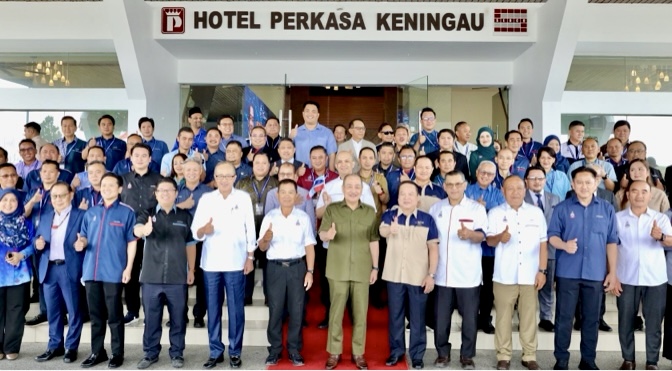
“Our task is to ensure that this potential can be translated into investment opportunities, jobs and increased income for the people,” he said at the opening of the 29th Sabah District Officers’ Conference at Hotel Perkasa here on Monday.
“In this regard, I see the Blue Economy as a sector with great potential, particularly in rural areas. Sabah has vast marine resources, biodiversity and coastal areas.
“This potential must be harnessed prudently to create new economic opportunities and increase community incomes. I hope District Officers can help identify such potential and facilitate investments that are suited to the needs and strengths of each district,” he said.
Hajiji reiterated that for this year the State Government has a development allocation ceiling of RM12.02 billion for 1,173 programmes and projects under the 13th Malaysia Plan (13MP), the highest in the history of the Sabah Budget.
“The allocation ceiling covers 241 continuation projects and 932 new projects.However, the larger the allocation provided, the greater our responsibility to ensure that its implementation is truly effective,” he said.
Therefore, the Chief Minister wants every District Officer to pay serious attention to implementing projects and programmes in their respective districts.Monitoring must be carried out continuously.
If there are problems, they must be identified early, and if there are delays, identify the causes and take appropriate action.
He said District Officers and Assistant District Officers must also change the way they measure development success and not focus solely on the number of projects approved or completed.
“We must look at the impact on the people. Have their problems been resolved? Have their facilities improved? Have economic opportunities increased? Has their quality of life improved? These are the true measures of development success,” he said.
Hajiji assured that rural development will remain among the State Government’s priorities, particularly basic amenities such as roads, water and electricity supply.
“The same applies to housing, education, employment opportunities, entrepreneurship and community economic development. We want to continue narrowing the development gap between urban and rural areas,” he said.
The Chief Minister said the State Government will also continue to strengthen digitalisation in public service delivery.
He congratulated the Sabah Rural Development Ministry on developing the Online Rumah Mesra Sabah Maju Jaya Application, describing it as an important step toward making government service delivery faster, more transparent, and people-friendly.
“I hope this application will continue to be enhanced, including through the use of artificial intelligence or AI. This technology can help the people obtain information more easily, while also simplifying the application and checking processes.
The Chief Minister also wants the work culture within district administration to continue to be strengthened.
“We want fast service, accurate decisions and good governance, and every action must always place the interests of the people as the priority.
“We cannot allow development planning to change every time there is a change. The people need continuity, investors need confidence and the government machinery needs a clear direction,” he said.
“The success of the government is not measured merely by the policies announced or the amount of allocations provided, but by the changes that can be seen and felt by the people.
“When roads improve, water supply improves, economic opportunities increase and the people enjoy a better quality of life, then those are the true outcomes of development,” he said.
He called on them to work together to strengthen district administration and improve the quality of service delivery.
“Make the District Office an institution that is efficient, responsive, has integrity and is close to the people. With the commitment of the entire government machinery, I am confident that we can maintain the continuity of the state’s development and successfully implement Sabah Maju Jaya 2.0 for a more advanced, prosperous and thriving Sabah,” he said.-pr/BNN