KOTA KINABALU: Technical and Vocational Education and Training (TVET) must continue to be strengthened to help produce a skilled and competitive workforce for the oil and gas industry job market, said Chief Minister Datuk Seri Panglima Haji Hajiji Haji Noor.
In this context, he said institutions of higher learning and skills training centres have an important role to play by offering more courses and programmes related to the oil and gas industry.
“This year, a total of RM39.24 million has been allocated under the Ministry of Education, Science, Technology and Innovation to implement human capital development programmes, with a focus on TVET as well as several other programmes including Science, Technology, Engineering and Mathematics (STEM); innovation and digital technology; and oil and gas.
“In addition, there are language courses and training; Information and Communications Technology (ICT); hospitality, safety and health; agriculture; as well as training in the oil palm plantation sector. I am confident that all these efforts, including the establishment of the Sabah TVET Council last year, will bring about an important paradigm shift in the State’s TVET development landscape.
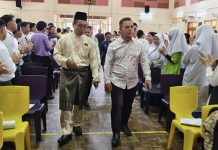
“TVET can no longer be regarded merely as an alternative, but must instead be embraced as a mainstream choice in efforts to produce a skilled workforce capable of shaping Sabah’s future,” he said when officiating the MYFutureJobs X Oil & Gas Kota Kinabalu 2026 Career Carnival at the Sabah International Convention Centre (SICC) here on Saturday.
His speech was delivered by Deputy Chief Minister II cum Finance Minister Datuk Seri Panglima Masidi Manjun.
Meanwhile, the Chief Minister said activities related to oil and gas, tourism and trade are among the important drivers of Sabah’s economy, reflecting the diversity of economic opportunities available in the State.
“Sabah’s economic growth is supported by several key sectors. The construction sector recorded the highest growth at 28.3 per cent, followed by manufacturing at 5.0 per cent, mining and quarrying at 4.9 per cent and services at 4.5 per cent.
“The development of all these sectors shows that the pattern of employment opportunities in Sabah is also changing in line with economic growth and industry requirements, thereby creating demand for workers with the appropriate skills,” he said.
He said based on statistics from the Department of Statistics Malaysia (DOSM), Sabah’s labour market has shown improving trends, with the State having about 1.90 million people in the labour force in the second quarter of 2026, of whom 1.23 million were employed, while about 106,600 were unemployed.
“Efforts by the Ministry of Human Resources (KESUMA) through the Social Security Organisation (PERKESO) also showed that 71,821 job placements were successfully recorded in Sabah between 2020 and July 24, 2026.
“This achievement reflects the Government’s continued commitment to helping Sabahans secure employment and improve their economic well-being. Therefore, today’s career carnival is timely in increasing the participation of our young people, particularly in the State’s oil and gas industry.
“The participation of 30 employers offering more than 3,000 job opportunities at the carnival demonstrates the commitment of all parties to opening up more career opportunities for Sabahans, particularly job seekers in the State,” he said.-pr/BNN