
KOTA KINABALU: Sabah has the potential to become a centre for integrative medicine research and development by leveraging its rich biodiversity and the traditional knowledge of local communities, said Chief Minister Datuk Seri Panglima Haji Hajiji Haji Noor.
He said Sabah’s rich biodiversity and the traditional knowledge of local communities should be documented and studied responsibly to explore their potential in improving public health and well-being.
He said such efforts must be undertaken with the consent and participation of local communities, while ensuring that their contributions were recognised and the benefits of research shared fairly.
“I hope local researchers will seize this opportunity to study and introduce Sabah’s herbal products and traditional practices to the international community in a responsible manner.
“As we expand our approaches to healthcare, patient safety and scientific evidence must always remain our top priorities.
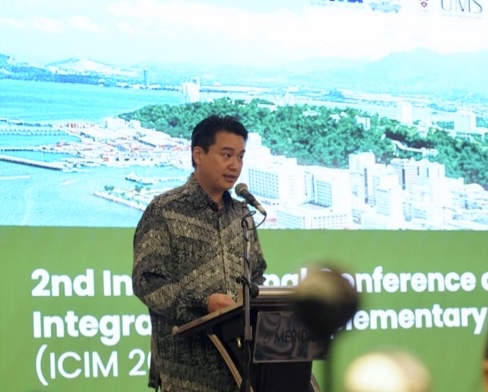
“Respect for tradition must be accompanied by careful evaluation of the effectiveness, quality and suitability of these practices,” he said at the opening of the 2nd International Conference on Integrative and Complementary Medicine (ICIM 2026) here today.
His speech was delivered by Assistant Minister to the Chief Minister Datuk Ceasar Mandela Malakun.
Hajiji said collaboration among universities, healthcare authorities, practitioners and communities was essential to strengthening research and providing clear information to enable people to make more informed healthcare decisions.
He expressed hope that Universiti Malaysia Sabah (UMS) would continue to play its role in bridging academic knowledge, healthcare services and local knowledge through collaboration with the Sabah State Health Department, professional partners and communities.
He said the world was facing increasingly complex health challenges, making it necessary to broaden healthcare approaches rather than relying on a single method.
“Integrative medicine promotes a holistic approach to health, encompassing prevention, nutrition, lifestyle, mental well-being and family support.
“Sabah’s development must be accompanied by efforts to build a healthy and resilient society, from children to senior citizens,” he said.
Hajiji said Sabah’s ethnic, linguistic, religious and cultural diversity also gave the state an advantage in contributing to the advancement of integrative medicine.
He said effective healthcare services must take into account the circumstances of patients’ lives, including their diet, family relationships, social connections, spirituality and environment.
He said respecting patients’ languages, beliefs and values could encourage open communication and strengthen trust in healthcare teams.
Meanwhile, Hajiji said the organisation of ICIM 2026 was in line with the State Government’s aspiration to position Sabah as a centre of academic and research excellence, as well as a medical tourism hub.
He said the conference also provided opportunities to strengthen collaborative networks between local institutions and international experts in efforts to improve the quality of healthcare services for the people.
“The State Government is committed to improving public health. Let us make full use of this platform to generate ideas and forge collaborations that will make healthcare more inclusive, affordable and effective,” he said.
He also expressed hope that the two-day conference, which brought together medical professionals, researchers, practitioners and educators, would lead to sustained collaboration through joint research, professional training and community programmes.
Hajiji also congratulated the Malaysian Medical Association, particularly its Integrative Medicine Committee, and UMS for jointly organising the conference.-pr/BNN


