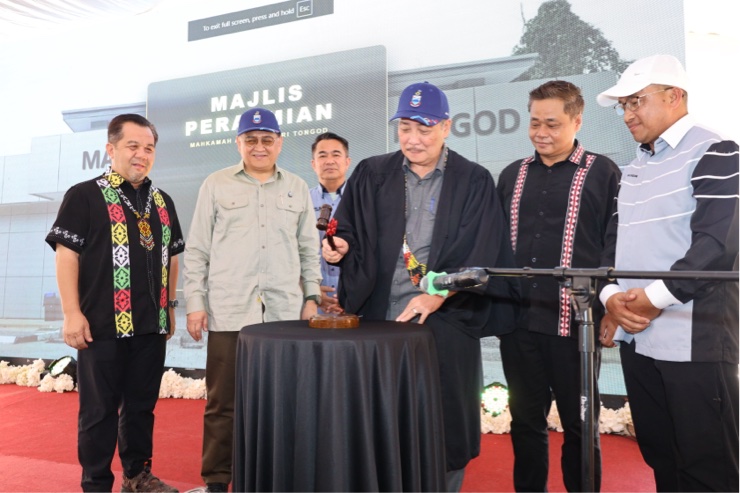
TONGOD: The State Government continues to strengthen the Native Court institution in Sabah through infrastructure development and improvements to the customary administration system, in line with the Sabah Maju Jaya agenda which emphasises the well-being of the people and social stability in the state.
Chief Minister Datuk Seri Panglima Haji Hajiji Haji Noor said the commitment is reflected in the construction of Native Courts in several districts, including Tongod, Putatan, Nabawan, Papar, Tamparuli and Sook, as well as in new projects currently in the tendering process in Kota Kinabalu and Paitan.
He said the continuous efforts have proven that the State Government is not only focused on economic and physical development, but also places importance on strengthening people’s institutions, including the Native Court, as an important platform for preserving harmony among Sabah’s multi-racial and multicultural society.
“Efforts to strengthen the Native Court must continue by ensuring its jurisdiction is clear and sufficient, in addition to building a strong institutional structure supported by officers with integrity and credibility.
“Improvements to procedures that are more modern, systematic and effective must also be implemented in line with current needs,” he said when opening the Tongod Native Court here on Wednesday.
Hajiji said the State Government greatly appreciates the role of District Chiefs, Native Chiefs, Assistant Native Chiefs, Village Heads and all members of the Native Court institution who serve as important links between the government and the people at the grassroots level.
He said the group plays a major role in ensuring social harmony continues to be preserved, especially in Sabah, which is rich in ethnic, customary and cultural diversity.
He also reminded all customary leaders and Native Court personnel to continue improving their performance in managing and resolving complaints and disputes within the native community.
“Those holding positions related to customs must understand the relevant customary practices and customary laws,” he said.
Meanwhile, Hajiji said the construction of the Tongod Native Court building is highly meaningful not only to the people of the district, but also to all Sabahans, as it reflects the State Government’s continuous commitment to empowering the Native customary institution.
He said the building, which began operations earlier this year, has become an important landmark for Tongod and is expected to improve customary judicial service facilities in the district.
“Customary institutions should not merely be viewed as part of old heritage, but must continue to be strengthened as relevant institutions in maintaining social harmony,
resolving customary disputes, preserving community unity and helping to strengthen social stability in Sabah,” he said.
He said the State Government will also continue to ensure that all Sabahans have access to basic amenities, economic opportunities, and a better quality of life through balanced regional development.
He said Tongod has huge potential in the agriculture and eco-tourism sectors and is also known as “The Heart of Sabah” due to its location in the centre of the state and its rich natural environment, tropical forests, and unique biodiversity.
He said Tongod’s natural attractions, including Imbak Canyon, can attract more tourists and help generate income for the local community.
The Chief Minister is optimistic that Tongod will undergo a transformation should a proposal by the private sector in collaboration with the State Government to develop a new township on a 1,000-acre site become a reality.-pr/BNN