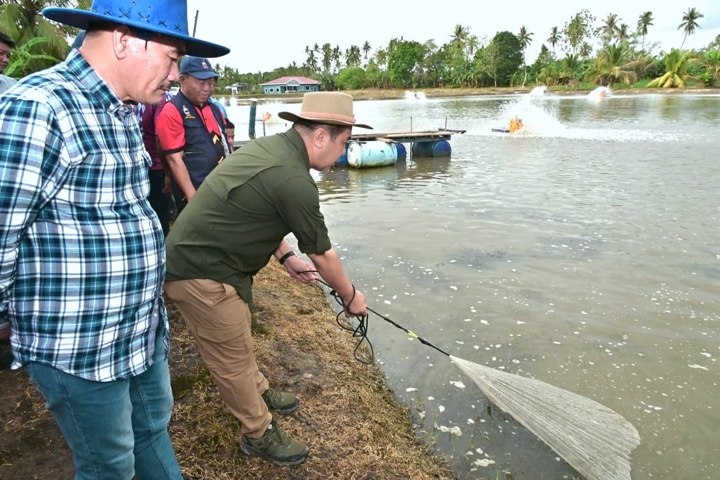
BEAUFORT: The State Government, through the Ministry of Agriculture, Fisheries and Food Industries (MAFFI), will continue to strengthen Sabah’s aquaculture industry by supplying shrimp fries stock, storage facilities and technical support to improve farmers’ productivity and incomes.
Minister of Agriculture, Fisheries and Food Industries Datuk Jamawi Jaafar said the initiative aligns with the government’s commitment to assist local producers in expanding shrimp farming enterprises, which offer attractive returns.
He made the remarks during a visit on Friday to shrimp-farming projects in Kampung Bintuka, accompanied by the State Assemblyman (ADUN) for Lumadan and the Member of Parliament for Sipitang.
He said about six operators are currently farming the area, which covers roughly 50 acres in total and produces fresh shrimp for markets in Kota Kinabalu and Brunei.
“The farmers here have succeeded in producing shrimp that meet the standards required by the market, including seafood restaurants in Kota Kinabalu.
“Today I came to see their needs for myself and, as a start, we will provide 500,000 shrimp post-larvae for use in the existing ponds in the area,” he told reporters.
Jamawi said the Ministry has also agreed to help provide a centralised shrimp storage and processing facility that can be used jointly by all operators in the area.
A suitable site has been identified for constructing holding ponds and an improved cold storage system to ensure harvests can be managed more efficiently.
“During harvest seasons, some produce cannot always be picked up immediately by buyers. With this facility, farmers will be able to store their catch more effectively before marketing it.”
“This will help ensure the shrimp remain fresh, and the proposed storage system can preserve product quality for up to a month,” he said.
He added that the agriculture, fisheries and livestock sectors can generate substantial income if managed systematically and viably.
“One shrimp pond can produce up to 10 tonnes of shrimp, with production value reaching about RM250,000 per pond.”
“That is why I frequently emphasise that agriculture, fisheries and livestock can provide lucrative returns to operators, especially village residents, if managed well and planned carefully,” he said.
Jamawi also expressed his gratitude that the shrimp farmers in Kampung Binsuluk remain enthusiastic about continuing their operations despite challenges facing the industry in some other areas.
“I found that most farmers here still have a strong spirit to continue shrimp farming. Elsewhere, some face problems such as disease, water supply and other factors that affect their operations.
“However, conditions here are relatively good and there are Fisheries Department officers who continually assist and monitor the farmers’ needs,” he said.
He said the Sabah Fisheries Department (DOF) has also been instructed to hold further discussions with the farmers to identify additional needs the government can support.
Among the requirements raised was the provision of aeration equipment or pond aerators to improve farm quality.
“There is allocation for such needs within the Fisheries Department. I ask that implementation is carried out in a more organised manner and, if possible, we will do it this year; if not, it will be brought forward for implementation early next year,” he said.
He said the species being farmed in the area is whiteleg shrimp, Penaeus vannamei, one of the most popular species in aquaculture and in high demand in local and international markets.
Earlier, Jamawi visited Kampung Binsuluk to view local belacan and anchovy production.
Also present were the Assistant Minister and ADUN for Lumadan, Datuk Haji Ruslan; Member of Parliament for Sipitang, Datuk Matbali Musah; Beaufort District Officer Mohd Nazri Ajun; Chief Assistant Director of the Resources, Conservation & Research Division, Sabah Fisheries Department (DOF) Irman Isnain; Head of Marine Aquaculture Development, Moris Chong; and Beaufort District Fisheries Officer, Abdul Adnan Amna.-pr/BNN