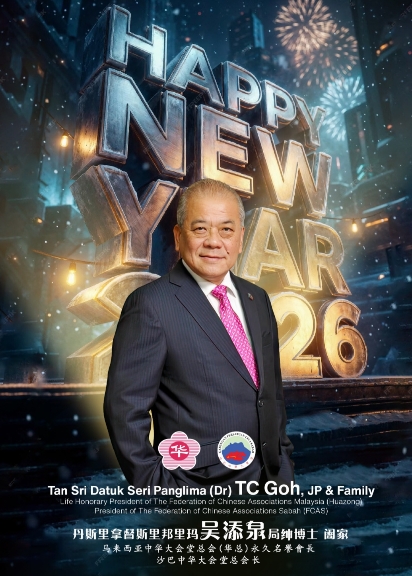
KOTA KINABALU : Tan Sri T. C. Goh, Life Honorary President of Federation of Chinese Associations Malaysia (Huazong) and President of the Federation of Chinese Associations Sabah (FCAS), New Year’s Message: Striving Together to Create a Better Future
As time passes and we look back on the past while looking ahead to the future, it is my hope that the entire nation and the Chinese community will continue to move forward with a spirit of unity and sincerity, an inclusive mindset, and steady steps, persevering through these challenging times.
Over the past year, our country has achieved what can be described as high points in international diplomacy, especially while serving as the ASEAN Chair. Numerous important international summits and meetings, including the ASEAN Summit and the ASEAN Plus Three Summit, were held in Kuala Lumour. In addition, many world leaders, including those from China and the United States, came to attend these meetings and paid official visits, placing our nation in the global spotlight.
Furthermore, since assuming office, Prime Minister Datuk Seri Anwar Ibrahim has continued to actively pursue multifaceted diplomatic engagements, visiting many countries to attract investments and bring foreign capital into the country—efforts that have been widely recognized and affirmed.
However, during the same year, the domestic situation has remained fraught with challenges. These include a rapidly shifting and confrontational political landscape, the rise of extreme racial and religious ideologies and the provocations they bring, the need to revitalize the economy, and the public’s expectations for improved governance and efficiency across government agencies—all of which are issues of serious concern.
In addition to rising prices and living costs, some federal government policies have also drawn criticism and public dissatisfaction. Examples include the Inland Revenue Board’s delays in refunding overpaid taxes to businesses over several years, the expansion of the Sales and Services Tax (SST), alcohol bans and halal certification issues, the progress of fulfilling the Malaysia Agreement 1963 (MA63), which is of great concern to the people of East Malaysia, as well as Sabah’s ongoing efforts to realize its entitlement to 40% of net tax revenue.
For Sabah, the past year also saw the completion of a state election. During this smooth and peaceful transition of power, which resulted in Datuk Seri Haji Hajiji Noor continuing to lead the new state government, the Chinese community and other ethnic groups—despite talk of an alleged “countercurrent”—generally exercised their democratic rights through concrete action and the ballot box, casting a vote for “localism and autonomy.”
However, with the state election now over, the new year will bring a parliamentary and a state by-election, where both the government and opposition will once again face off. Nevertheless, these contests are not expected to have a major impact on the overall national or state political landscape, and the outcomes remain to be seen.
Following the High Court’s ruling and the federal government’s decision not to appeal, the issue of fulfilling Sabah’s entitlement to 40% of net tax revenue will be closely watched in the coming year. This long-standing demand represents one of the greatest hopes and calls of the Sabah government and its people.
That said, I would suggest that once this is fully implemented, while it will bring greater tax revenue to Sabah, the government must also manage it with the highest level of transparency and sound mechanisms, ensuring that every cent of the net tax revenue is properly utilized and fully directed toward Sabah’s development and the well-being of all its people.
In addition, I hope that the extreme racial and religious issues stirred up by certain politicians in Peninsular Malaysia will not “spill over” into Sabah or East Malaysia. This unacceptable practice of deliberately inflaming such issues for political gain has occurred frequently in recent years in Peninsular Malaysia, leading to the division of the people and the tearing apart of society and the nation.
I believe that for a country like ours, which is composed of diverse races and circumstances, this long-standing practice by some West Malaysian politicians of pursuing “extreme populist” politics is extremely dangerous and irresponsible, and must be stopped immediately.
In the new year, whether in Sabah or at the federal level, both the government and the people must work together in full cooperation—standing against extremism and upholding moderation.
We hope the government will govern well, strictly control the continuously rising cost of living, help reduce individual and household debt, and introduce comprehensive healthcare, retirement, and elderly welfare policies, so as to bring the people a greater sense of happiness and well-being.-pr/BNN