KOTA KINABALU: Chief Minister Datuk Seri Panglima Haji Hajiji Haji Noor said plans are in motion to achieve the RM100 billion Gross Domestic Product (GDP) target by 2030 under the Sabah Maju Jaya (SMJ) development agenda.
“We have identified the industries we want to develop, the investments we want to attract and the infrastructure needed to support them. The priority now is to make sure these plans are carried through,” he said.
Hajiji said one of the most important requirements for Sabah’s industrial development is reliable, affordable energy.
“When investors consider setting up factories or other major operations in Sabah, they need to know whether we can provide sufficient electricity and gas, how much it will cost, and when the supply will be available.
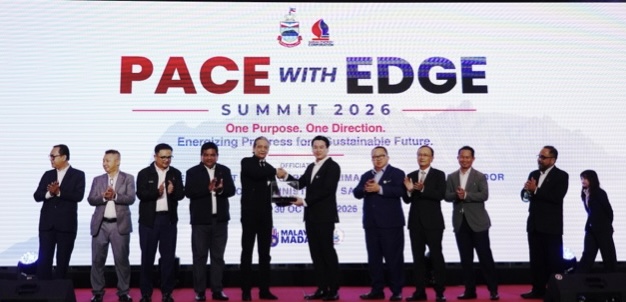
“These are practical questions, and they expect clear answers. After all, investors cannot operate their factories based on promises of future energy supply. They need to know what we can actually deliver,” he said at the opening of the Sabah Energy Corporation (SEC) Planning Annual Conference (PACE) with EDGE Summit at the Magellan Sutera Resort here on Thursday.
Assistant Minister to the Chief Minister Datuk Ceasar Mandela Malakun delivered the Chief Minister’s speech. The Chief Minister said natural gas will continue to play an important role in meeting Sabah’s energy requirements, even as the State develops more renewable energy sources.
“We have to balance Sabah’s growing energy needs with affordability and environmental sustainability. There are difficult decisions involved, but these are decisions we must make carefully if Sabah is to remain competitive,” he said.
Hajiji said the State Government has made encouraging progress in strengthening Sabah’s participation in the energy sector.
“Through the Commercial Collaboration Agreement signed with PETRONAS in December 2021, the State has secured a greater role in the development of its oil and gas industry.
“More recently, the Long-Term Gas Supply and Delivery Plan presented to the State Government in September projected that Sabah’s gas supply could increase from approximately 700 million standard cubic feet per day to 1,350 million by 2030.
“The planned development of gas resources on the East Coast also offers new opportunities for electricity generation and industrial growth in that region.
“These developments are encouraging. What matters now is ensuring that the projects proceed as planned and that the expected benefits are realised,” he said.
The Chief Minister commended the SEC on its financial performance and its efforts to expand into new areas under its Progressive Energy Transformation Agenda, PETA 2030.
Since its inception in 1981, SEC has grown into one of Sabah’s most important energy companies, with a much greater role today in gas supply, transportation and distribution, he said.
Hajiji called on other State Government-linked companies (GLCs) and agencies to emulate SEC’s efforts to contribute to the State’s economic growth.
“Each State agency and GLCs has its own important role to play, but even if every organisation performs well individually, that does not necessarily mean we are delivering well collectively.
“There must be good coordination between them, particularly when their responsibilities come together in supporting a major investment,” he said.
He said Sabah cannot afford to have its agencies working in silos, which would only leave investors waiting and opportunities going elsewhere.
“We cannot afford that, especially when Sabah is competing with other investment destinations. I therefore hope to see our State agencies and GLCs continue strengthening their cooperation, sharing information and resolving problems together, rather than allowing organisational boundaries to slow things down.
On the Summit, Hajiji hoped the ideas exchanged here would lead to practical improvements, new partnerships, and better ways of working together.-pr/BNN