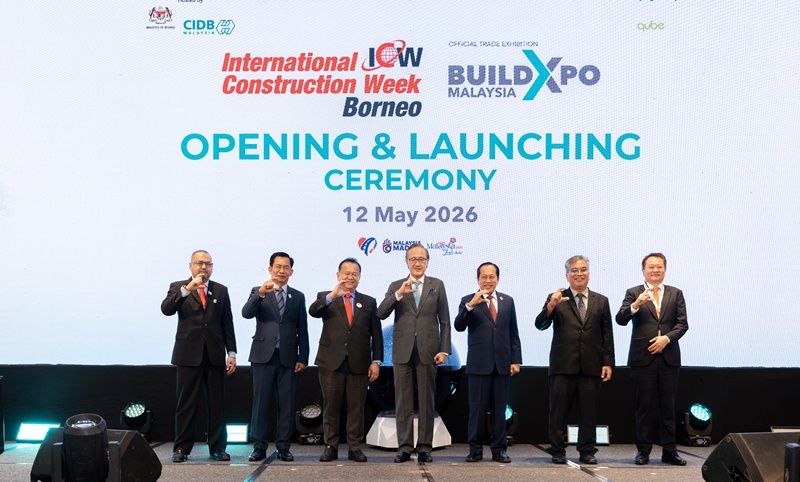
KOTA KINABALU: The International Construction Week (ICW) Borneo 2026 was officially inaugurated today in Kota Kinabalu, marking the second edition of this regional platform that facilitates national-level dialogue, technical expertise exchange, and capacity-building for stakeholders in East Malaysia’s construction industry.
The opening and launch ceremony was officiated by Datuk Seri Panglima Masidi Manjun, Deputy Chief Minister II of Sabah, representing Datuk Seri Panglima Hajiji Noor, Sabah’s Chief Minister, in the presence of Dato Sri Alexander Nanta Linggi, Minister of Works Malaysia, and Datuk Seri Dr Ahmad Maslan, Deputy Minister of Works, along with senior government officials, industry leaders, and professionals from the built environment sector.
Hosted by the Ministry of Works Malaysia and the Construction Industry Development Board (CIDB) Malaysia, and co-organised by Qube Integrated Malaysia Sdn Bhd, ICW Borneo 2026 builds upon the success of its inaugural edition held in Kuching, Sarawak last year. The event underscores a steadfast commitment to expanding industry knowledge access, boosting regional participation, and fostering more inclusive development across Malaysia’s construction ecosystem.
With East Malaysia experiencing increasing infrastructure development and a heightened focus on sustainability, ICW Borneo 2026 serves as a timely platform to support Sabah’s evolving construction landscape.
In his speech, read by Manjun, Hajiji highlighted, “Sabah is at a pivotal moment. For many years, we have been celebrated for our natural beauty and, at times, defined by our development challenges. But that narrative is changing—and it is changing with purpose.”
“Through the Sabah Maju Jaya 2.0 Roadmap (2026–2030), we are entering a new phase of growth—one centred on strengthening our economic resilience, improving productivity, and creating long-term value for our people.”
“The construction sector will play a vital role in this transformation. Moving forward, our focus is clear: to improve execution, enhance coordination, and ensure projects are delivered efficiently, transparently, and with lasting impact.”
Meanwhile, Dato Sri Alexander Nanta Linggi, Minister of Works Malaysia, stated that the Federal Government, via the Ministry of Works and CIDB Malaysia, has invested over RM150 million to bolster Sabah’s construction ecosystem through digitalisation, technical excellence, and workforce development.
“The construction sector remains a key driver of Malaysia’s progress, and Sabah possesses significant potential in infrastructure, sustainable development, and regional connectivity,” he said.
He added that CIDB Malaysia has established BIM training facilities in Kota Kinabalu with an investment of RM2.25 million to enhance local industry capabilities in Building Information Modelling (BIM)—a crucial technology for increasing productivity and project efficiency. The agency has also upgraded Makmal Kerja Raya Malaysia (MKRM) Sabah into an internationally accredited testing facility, offering advanced materials testing, inspection, and technical support services, supported by a federal investment of approximately RM19.4 million.
Furthermore, CIDB has committed RM130.6 million to construct a new eco-campus in Sabah—set to be the most modern Akademi Binaan Malaysia (ABM) campus in Malaysia, capable of accommodating up to 700 trainees at a time. The groundbreaking in Beringgis, Papar, was officiated last year by the Sabah Chief Minister alongside the Minister of Works.
Since 2001, ABM Sabah has trained over 195,000 Sabahans, creating pathways to meaningful employment in construction both locally and internationally.
These initiatives, totalling over RM150 million, reflect a deep commitment to providing Sabah with world-class facilities, technical expertise, and skills development opportunities comparable to those elsewhere in Malaysia.
Nanta Linggi emphasised that the strong participation in ICW Borneo 2026 signals confidence in Sabah’s future. “Through BuildXpo Malaysia (Borneo), we showcase innovative technologies and solutions from Europe, China, Kuala Lumpur, Sarawak, and Sabah. Their presence underlines the great opportunities Sabah offers for infrastructure development, sustainable construction, and industrial growth.”
ICW Borneo exemplifies what can be achieved when government, industry leaders, technology providers, and practitioners unite to exchange ideas, forge partnerships, and develop practical solutions.
He cited the success of ICW and BuildXpo 2025 in Kuala Lumpur, where seven memoranda of understanding were signed with companies from Malaysia, Cambodia, Singapore, China, and South Korea. The International Sourcing Programme, organised with MATRADE, facilitated 89 business meetings with foreign buyers from 11 countries, generating projected sales of RM1.4 billion.
These accomplishments highlight ICW and BuildXpo’s potential not only as platforms for knowledge sharing but also for generating tangible business opportunities, attracting international partnerships, and opening new markets for industry players.
Nanta Linggi described ICW Borneo as a model with significant potential for further expansion in Sabah. With robust support from the Sabah Government and private sector, the platform can continue strengthening the state’s construction ecosystem and position Sabah as a regional hub for innovation, skills development, and sustainable infrastructure.
Aligned with the broader ICW 2026 theme, “Beyond Limits,” this year’s Borneo edition encourages the industry to transcend traditional practices and accelerate transformation through innovation, collaboration, and digitalisation.
A key highlight is the Construction Sustainability Summit (CSS) 2026, themed “From Ambition to Action: Delivering Sabah’s Sustainable Future,” which gathers policymakers, industry leaders, and professionals to explore practical pathways for advancing sustainable infrastructure, ESG adoption, and low-carbon construction.
The event also features technical sessions such as “Fair Contracts, Fair Outcomes – Managing Risks and Avoiding Disputes in Construction Projects,” “BIM Beyond Design: Towards Digital Construction in Borneo,” and the National Crane Competition Bootcamp & Talk.
Participants will visit Makmal Kerja Raya Malaysia (MKRM) Sabah, while approximately 150 trainees from ABM Sabah and CIDB Technologies will be celebrated during a graduation ceremony on the final day.
ICW Borneo 2026 has brought together around 1,000 participants from Malaysia and abroad—including industry leaders, policymakers, technical experts, and exhibitors from Europe, China, and across Malaysia—further cementing Sabah’s emerging status as a hub for construction innovation and collaboration.
The event also acts as a precursor to the flagship ICW and BuildXpo 2026, scheduled for 10 to 12 November at MITEC, Kuala Lumpur. This edition will feature a major international exhibition and co-located Glasstech Asia & Fenestration Asia 2026, creating expanded opportunities for business, innovation, and partnership.
ICW Borneo 2026 underscores the Federal Government’s dedication to strengthening Sabah’s construction industry through substantial investments in infrastructure, digital capabilities, and workforce training. The strong international and regional participation further affirms Sabah’s growing confidence as an emerging centre for construction innovation and collaboration in the region.-pr/BNN