KOTA KINABALU: Chief Minister Datuk Seri Panglima Haji Hajiji Haji Noor reaffirmed that the State Government remains steadfast in its commitment to strengthen human capital development through the implementation of the Sabah Maju Jaya (SMJ) 2.0 Roadmap.
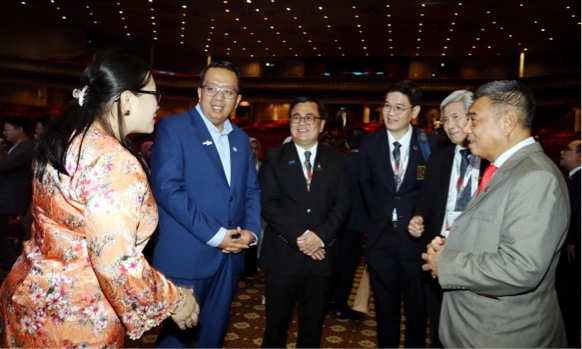
“This will help produce a stronger pipeline of skilled workers equipped to meet the needs of future industries, particularly in Artificial Intelligence (AI), digital technology, and other high-impact strategic sectors,” he said at the opening of the International Conference Association of Southeast Asian Institutions of Higher Learning (ASAIHL) at the Chancellor Hall, Universiti Malaysia Sabah (UMS) near here today.
His speech was delivered by Dr Andi Md Shamsureezal, Assistant Minister of Tourism, Culture and Environment ,Hajiji said the ASAIHL conference theme, “Bridging Borders and Building Futures:Lifelong Learning for Sustainable Development and Digital Transformation in Asia,” is timely in an era of rapid transformation.
The Chief Minister said, in terms of lifelong learning, Sabah faced complex challenges, ranging from its vast geographical terrain, which includes coastlines, highlands, and remote interior communities, to a population marked by rich ethnic and cultural diversity.
“We also face the digital divide between urban and rural areas. Nevertheless, we have taken proactive steps to address these challenges by among others, by encouraging cooperation among Sabah’s institutions of higher learning, community colleges, vocational centres, and non-governmental organisations to expand the reach of continuing education,” he said.
“The question before us is not whether lifelong learning matters. Rather, it is how we build the systems, partnerships and mindsets that make lifelong learning accessible, equitable, and effective for all,” he said.
Hajiji said AI is reshaping how people work, while the continuous introduction of new technologies requires industries and professions to adapt.
The integration of artificial intelligence, big data analytics, machine learning, and digital platforms into every facet of human activity is reshaping education, commerce, governance, and social interaction, he said.
“For universities across Asia, this presents both an extraordinary opportunity and a formidable challenge. The opportunity lies in our ability to reach learners we have never been able to reach before through online platforms, micro-credentials, virtual classrooms, and AI-assisted personalised learning.
“Today, I am particularly encouraged by the presence at this conference of thought leaders engaged in digital transformation and innovation in education.
“I was informed that the conference has attracted twelve papers from researchers across the region. This is exactly the kind of intellectual engagement we need, one that translates technological possibility into educational reality,” he said.
The Chief Minister is also heartened to note that ASAIHL 2026 has attracted participants from eight countries – Malaysia, Indonesia, Thailand, the Philippines, Iran, Uzbekistan, Cambodia and France – reflecting a truly diverse tapestry of academic traditions, policy contexts and lived experiences.
“This diversity is not merely a logistical achievement. It is the substance of what makes international academic exchange so powerful,” he said.
He also commended UMS for its role in the endeavour and that through its outreach programmes, professional development initiatives, and community engagement activities, the university is steadily strengthening its position as a lifelong learning partner for the people of Sabah.
“I hope more like-minded institutions and organisations will emulate such efforts to promote lifelong learning,” he said.-pr/BNN