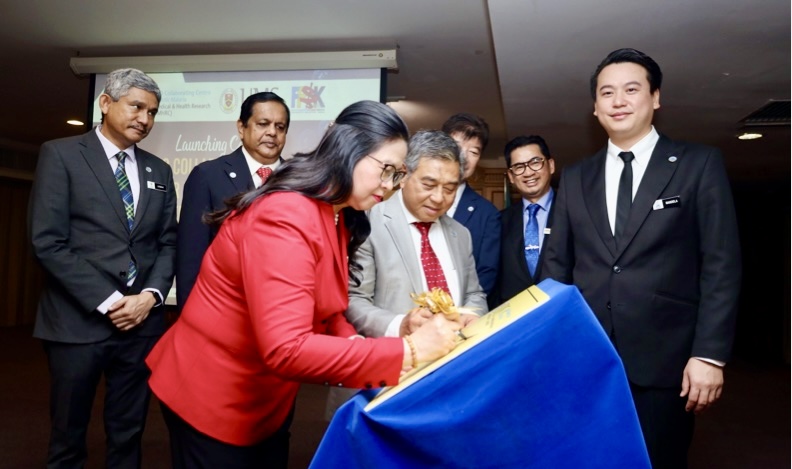
KOTA KINABALU: Chief Minister Datuk Seri Panglima Haji Hajiji Haji Noor described the opening of the World Health Organisation (WHO) Collaborating Centre for Zoonotic Malaria at Universiti Malaysia Sabah as a significant milestone for Sabah.
“Its designation recognises UMS’ expertise and contributions to malaria research, particularly its work on Plasmodium knowlesi. It is an achievement that brings recognition not only to UMS, but also to Sabah and Malaysia,” he said at the opening ceremony at the UMS Chancellory Building Event Gallery on Monday.
Assistant Minister to the Chief Minister Datuk Ceasar Mandela Malakun delivered his speech.
The Chief Minister said Malaysia has made remarkable progress in malaria control and elimination, including interrupting indigenous transmission of human malaria parasites.
“Yet Plasmodium knowlesi presents a different challenge. Its transmission involves a complex interaction among humans, macaques, mosquitoes and the environment.
“This challenge is especially relevant to Sabah. Our rich biodiversity and the close interaction between communities, wildlife and forest environments mean that we must look beyond traditional approaches to malaria control,” he said.
Hajiji said addressing zoonotic malaria requires surveillance, research and vector control, alongside an understanding of wildlife and environmental change.
“Above all, it requires collaboration across sectors. This is where the One Health approach is so important.
“As Pro-Chancellor of UMS, I am proud that the establishment of this Centre brings together the strengths of UMS, the World Health Organisation, the Ministry of Health Malaysia, the Sabah State Health Department, and national and international partners.
“We must ensure that research findings lead to practical solutions and public health action, while investing in the young researchers and health professionals who will carry this work forward,” he said.
Hajiji said the Sabah State Government strongly supports initiatives that advance research, innovation and international collaboration.
“This Centre shows how a Sabah-based institution can contribute to an international public health agenda. It can also help position Sabah as a regional platform for collaboration on zoonotic malaria and One Health.
“Sabah’s experience can offer lessons to countries facing similar challenges, just as we can learn from our regional and international partners. This exchange of knowledge and expertise will strengthen us all,” he said.
“Congratulations to UMS, the Faculty of Medicine and Health Sciences, and the Borneo Medical and Health Research Centre on this important achievement. Syabas and well done!” he said.-pr/BNN