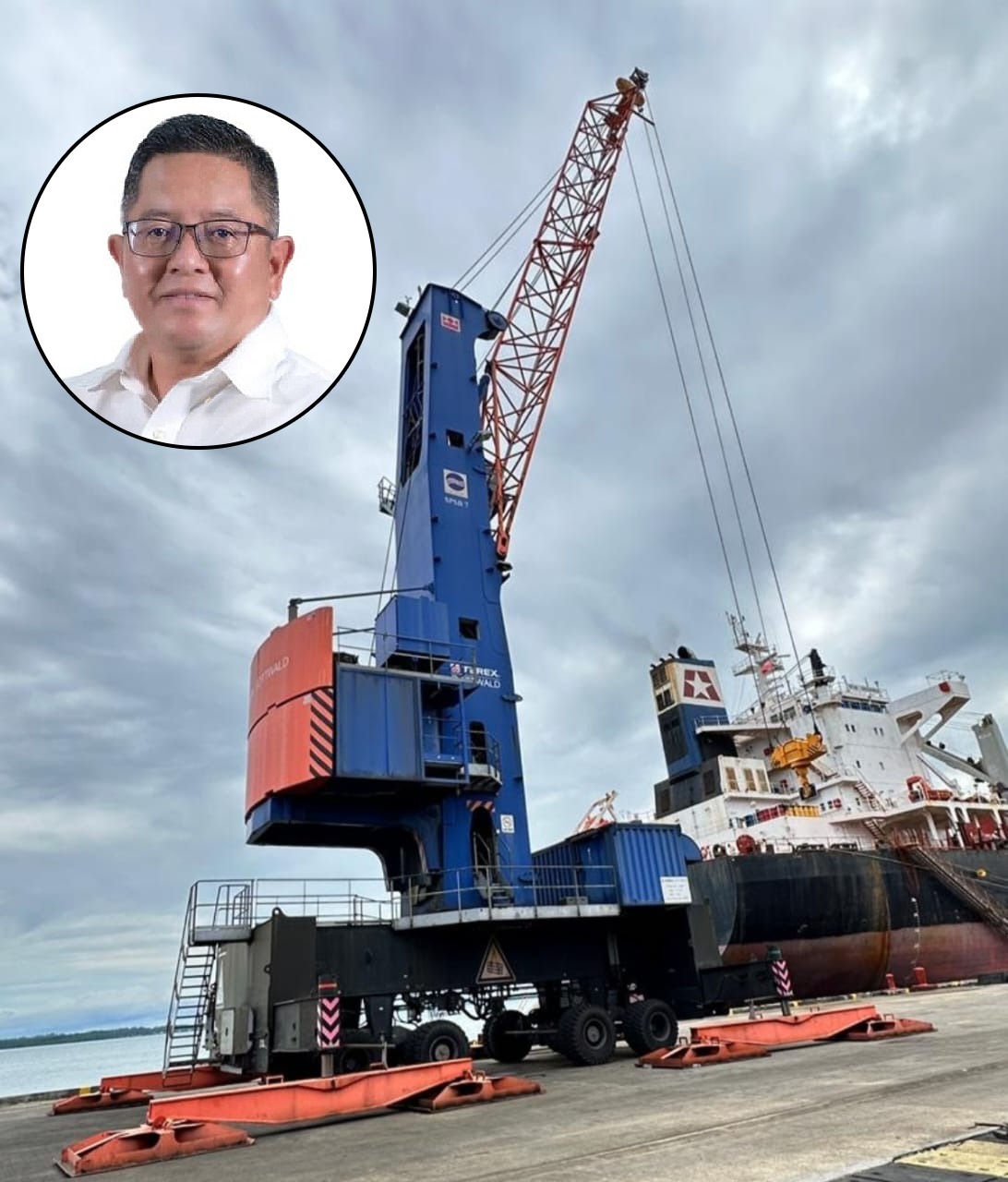
SANDAKAN: Port users are demanding an immediate, concrete solution to the prolonged breakdown of port equipment, warning that continued disruption could cause serious financial losses and further weaken Sandakan’s economy.
The Sandakan Forwarders Association (SFA), Sabah Shipping Agents Association and Sandakan Lorry Hire Transportation Association met today to discuss the latest breakdown of the Mobile Harbour Crane (MHC) and its impact on port operations.
SFA chairman and Sandakan Lorry Hire Transportation Association deputy chairman Chong Thien Ming said Sabah Ports had informed port users in a letter dated 5 October that repairs to the MHC would take about two months.
According to the information provided, two MHC units from Tawau are expected to be shipped to Sandakan by the end of October to support operations.
“However, the immediate question is: what are port users supposed to do between 5 and 30 October? Businesses cannot simply stop operating and wait another 25 days,” Chong said.
He also questioned what assurance Sabah Ports could give that the two units would reach Sandakan by the end of October.
“We have been told that the two MHC units from Tawau will be shipped to Sandakan by the end of October. But what guarantee is there that they will arrive on time and be ready for operation? Port users need certainty, not just an indication of when the equipment may arrive,” he said.
Chong said Sabah Ports had also asked vessels equipped with their own cranes to berth at Sandakan Port and carry out their own loading and unloading.
“This cannot be treated as a complete solution. Not every vessel has a crane, and vessel cranes are not capable of handling every type or volume of container.
“So what are shipping agents, forwarding agents, transport operators and the business community expected to do when their vessels cannot rely on the port’s own equipment?” he asked.
Chong said port users should not have to bear the financial consequences of prolonged equipment failure.
“If cargo is delayed, vessels are held up, containers cannot be moved, trucks are left waiting or businesses lose orders because of equipment failure, who will bear the losses?
“Sabah Ports, as the port service provider, must take responsibility for the consequences of equipment and operational failures. Port users should not be expected to absorb all the additional costs and losses caused by a problem beyond their control,” he said.
He said the latest breakdown reinforced why the three associations had been raising concerns about ageing port equipment for the past four years.
“We have repeatedly called for new assets and highlighted the condition of the MHCs, container stackers, container trailers and forklifts. Yet the response has continued to focus on insufficient TEU volume.
“But how can we increase TEU volume if the port does not have reliable equipment? Cargo volumes cannot grow when port users are constantly worried about whether their cargo can be handled.”
Chong said some MHC equipment had been in service for more than 20 years, while Sandakan remained heavily reliant on mobile harbour cranes.
He questioned Sabah Ports’ long-term commitment to Sandakan Port as a key economic gateway.
“Is the objective simply to operate at the current TEU volume, or is there a commitment to develop Sandakan Port and improve its competitiveness?
“If we want more shipping lines, more cargo and more business activity, we must first provide reliable port infrastructure and equipment.”
He said the disruption could affect the entire supply chain, including shipping and forwarding agents, transport operators, importers, exporters, manufacturers, traders and consumers.
Businesses could face additional storage, transport, vessel and container costs. Some might also have to postpone or cancel orders because they could not be sure when their cargo would move.
With Christmas and the New Year approaching, Chong said the uncertainty was particularly concerning for the business community.
“Last year, businesses already suffered tremendous losses when the MHC broke down. We cannot allow the same situation to happen again this year.
“The business community needs to know whether Sandakan Port can reliably handle its cargo before committing to new orders. Otherwise, businesses will have to take the risk themselves,” he said.
Chong urged the Sabah Government to intervene immediately and help Sabah Ports and affected stakeholders reach a concrete solution.
He also called on Deputy Chief Minister III Datuk Ewon Benedict to organise a town hall meeting with port users and service providers, similar to the engagement held in Kota Kinabalu.
“Let all parties sit down together and put the facts, problems, costs and solutions on the table. Most importantly, we need a clear timeline and accountability,” he said.
Chong said the associations’ proposals remained unchanged: Sabah Ports should invest in new, reliable port assets or consider privatising selected port services or operations to improve efficiency and accountability.
“We cannot continue with the same cycle of breakdowns, repairs, waiting and uncertainty.
“Sandakan Port is critical to the economy of Sandakan and Sabah’s east coast. If this situation continues, the impact will extend beyond the port. Businesses may scale back, postpone investment or eventually close.
“We need a permanent solution, not another temporary arrangement,” Chong said.-pr/BNN