KOTA KINABALU: Universiti Malaysia Sabah (UMS) must continue to leverage Borneo’s unique geopolitical position, rich biodiversity and cultural heritage to produce world-class human capital and lead discussions on the development of the nation and the island of Borneo as a whole.
Chief Minister Datuk Seri Panglima Haji Hajiji Haji Noor said the State Government highly valued UMS’ capabilities and academic leadership in continuing to play a significant role as a centre of academic excellence, high-impact research and strategic thinking at the regional level.
He said since its establishment, UMS had grown rapidly and proven its role as “The Brain of Borneo”, not only establishing itself as a leading institution of higher learning in northern Borneo but also becoming a symbol of academic and research excellence.
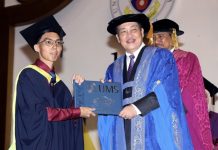
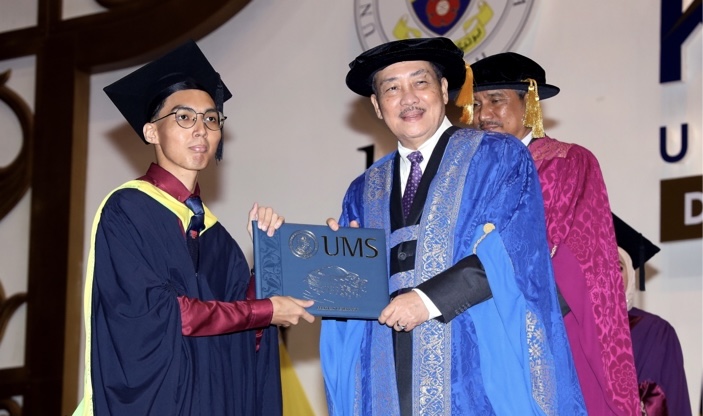
“As a leading institution in Borneo, UMS must continue to leverage Borneo’s unique geopolitical position, rich biodiversity and distinctive cultural heritage to produce world-class human capital,” he said at the 28th Universiti Malaysia Sabah (UMS) Convocation Ceremony at the UMS Chancellor Hall here today.
Hajiji, who is also UMS Pro-Chancellor said the State Government, through the Sabah Maju Jaya (SMJ) Development Roadmap, continues to make human capital development, education, technological advancement and digital transformation key drivers of the state’s progress.
He said opportunities in the blue economy, digital economy, entrepreneurship, environmental sustainability, and innovation require graduates to stay prepared to adapt to a rapidly changing world.
“The Sabah State Government remains committed and steadfast in its principle that no Sabahan should be deprived of access to quality higher education simply because of financial constraints or socioeconomic background,” he said.
He said the government’s commitment to educational development was not mere rhetoric but was reflected in increased education funding allocations amounting to hundreds of millions of ringgit annually.
He said the allocation for the Sabah State Government Scholarship (BKNS) had increased to RM161 million this year, representing a long-term investment in the state’s human capital development.
In addition, he said 14 educational assistance initiatives had been implemented to help Sabahans pursue their studies, including the One-Off Higher Education Institution Registration Cash Assistance, Computer Assistance, Special Examination Cash Assistance, Sabah Education Excellence Awards, Sabah Student Secretariat Malaysia, Sabah Student Flight Ticket Subsidy, Financial Contribution for Higher Education Students in Sabah and One-Off School Activity Contribution.
Hajiji said all these initiatives were aimed at expanding access to higher education, particularly for Sabahans from underprivileged families, while strengthening talent development and graduate employability through the Sabah Talent Blueprint, Technical and Vocational Education and Training (TVET) programmes and strategic collaboration with industry players.
He said such collaboration also helped meet the demand for highly skilled workers, including at the Sipitang Oil and Gas Industrial Park (SOGIP) and Kota Kinabalu Industrial Park (KKIP).
He also expressed pride in UMS receiving the Talentbank 6-Star Employer Choice recognition in Marketing, Hospitality Management and Tourism, based on an independent assessment involving more than 1,200 leading employers.
“This prestigious recognition proves that UMS graduates possess highly regarded competencies and are sought after by employers in the job market,” he said.
He said UMS graduates should use the knowledge they acquire to address real challenges facing society, drive the state’s economic growth, and safeguard environmental sustainability, while adding value to their families, communities, and Sabah’s development.
“Uphold the good name of your alma mater, embrace ethical values and be role models for the younger generation,” he said. On UMS’ role in addressing global challenges, including climate change, food security and the depletion of natural resources, Hajiji said the university played an important role through research and innovation that supported the Sustainable Development Goals (SDGs), particularly in green technology and food security.
He said the State Government continued to support UMS research aligned with the Sabah Energy Roadmap and Master Plan 2040 (SE-RAMP 2040) and Sabah Blue Economy initiatives, particularly in renewable energy development, modern aquaculture and marine resources.
He said UMS’ expertise, including through the Borneo Marine Research Institute (IMB), could contribute significantly to the development of the state’s blue economy.
Meanwhile, collaboration with the Sabah Ministry of Agriculture, Fisheries and Food Industry (MAFFI) opened up opportunities for research into smart agriculture, climate-resilient rice varieties, sustainable fisheries and biotechnology.
Hajiji expressed hope that UMS graduates would play an active role in the state’s development by applying their knowledge, skills and expertise to contribute to economic progress, community well-being and a brighter future for Sabah.-pr/BNN