KOTA KINABALU: The State Government is committed to strengthening human capital development through the implementation of the Sabah Maju Jaya (SMJ) 2.0 Roadmap to produce more skilled workers capable of meeting the needs of future industries, including artificial intelligence (AI), digital technology and other high-impact strategic sectors.
Chief Minister Datuk Seri Panglima Haji Hajiji Haji Noor said developing local talent is among the State Government’s key priorities to ensure Sabahans are able to fill high- quality jobs created through new investments and the growth of strategic economic sectors.
He said the government aims to see more Sabahans emerge as engineers, technologists, skilled technicians, data scientists, AI specialists and industry leaders capable of competing on the global stage.
“The State Government remains committed to implementing its people-centred development agenda through SMJ 2.0, with the goal of building a prosperous,
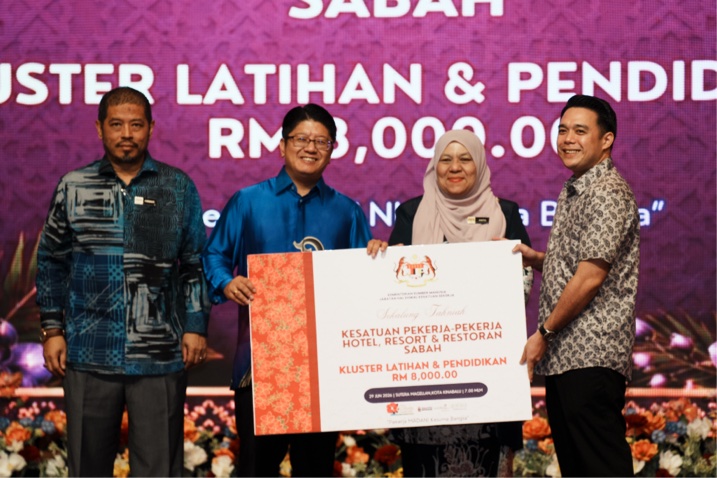
competitive and inclusive state where the benefits of development are shared by all, regardless of background,” he said at the presentation ceremony for the 2026 Trade Union Affairs Programme (PHEKS) assistance to Sabah trade unions at the Magellan Sutera Hotel here on Monday.
His speech was delivered by Deputy Chief Minister III and State Minister of Industrial Development, Entrepreneurship and Transport, Datuk Ewon Benedick. The event was graced by Sabah Head of State Tun Datuk Seri Panglima (Dr.) Musa Haji Aman.
Hajiji said the world of work is undergoing a major transformation driven by digital technology, automation and AI, reshaping the employment landscape while creating new career opportunities that require different skill sets.
In this regard, he said trade unions must move in tandem with these changes by strengthening organisational digitalisation, enhancing members’ skills through upskilling initiatives and complying with international standards.
He also called for closer collaboration between trade unions, employers, training institutions and government agencies to foster a culture of lifelong learning while expanding opportunities for reskilling and upskilling among workers.
According to him, this agenda is in line with the aspirations of SMJ 2.0, which places strong emphasis on Technical and Vocational Education and Training (TVET) as the primary pathway for producing a highly skilled workforce.
“TVET is no longer an alternative option. Instead, it has become a vital pathway in preparing the workforce required by future industries.
“Sabah has tremendous potential in the energy, oil and gas, blue economy, tourism, advanced manufacturing and green technology sectors, all of which require a competent and highly skilled workforce,” he said.
Hajiji said the success of the State’s development depends on strong collaboration between the government, employers and employees to foster harmonious and sustainable industrial relations.
He also urged employers to continue cultivating a fair, caring and ethical workplace culture, while encouraging workers to continuously upgrade their skills and knowledge to remain relevant to industry needs.
He said trade union leaders must continue to serve as responsible and forward-looking voices in championing workers’ welfare while contributing to the progress of the state and the nation.
At the same time, Hajiji said the government has always recognised the important role of trade unions as a bridge connecting the aspirations of workers, employers and the government, while serving as one of the catalysts for stable industrial relations and investor confidence.
He said that through the Trade Union Affairs Programme (PHEKS), the MADANI Government has allocated RM6.1 million for its implementation nationwide this year, including RM310,000 for 38 trade unions in Sabah.
“Use this allocation wisely and responsibly to enhance members’ competencies, strengthen organisational management systems and implement programmes that benefit workers,” he said.-pr/BNN