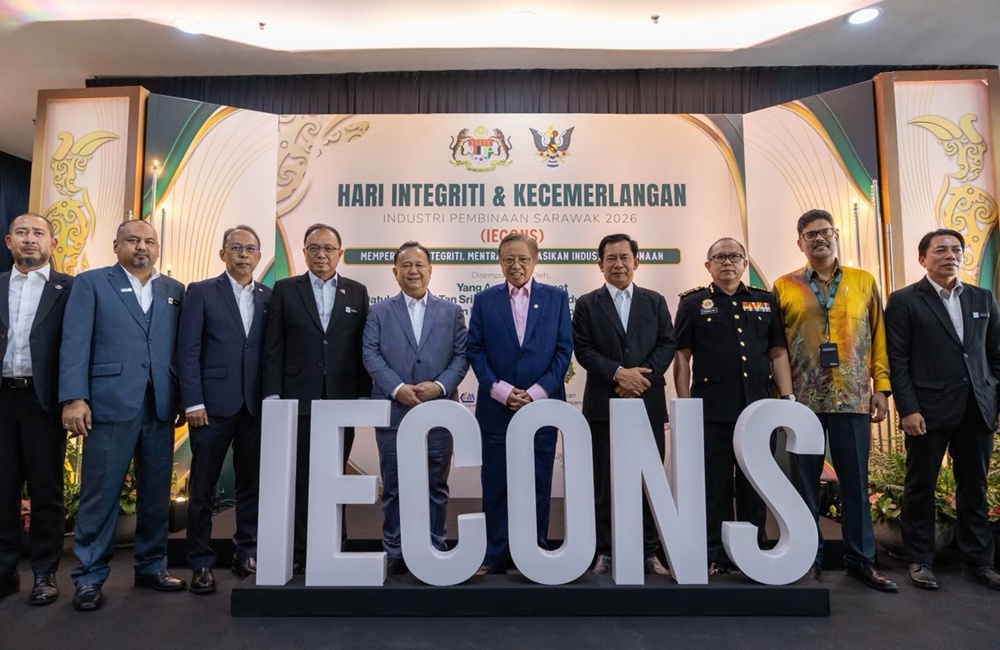
KUCHING: Good governance, transparency, and professionalism continue to be reinforced as the foundation of a more competitive construction industry through the Sarawak Construction Industry Integrity & Excellence Day (IECONS) 2026, a strategic platform organised by the Construction Industry Development Board (CIDB) Malaysia. Attended by 912 participants, the programme brought together representatives from government, regulatory bodies, enforcement agencies, industry players, professional associations, and academic institutions to promote a culture of integrity across the construction sector.
Officiated by the Premier of Sarawak, Datuk Patinggi Tan Sri (Dr) Abang Haji Abdul Rahman Zohari bin Tun Datuk Abang Haji Openg, the event, themed “Empowering Integrity, Transforming the Construction Industry” , featured a series of knowledge-sharing sessions on governance, corruption prevention, the implementation of MS ISO 37001:2016 Anti-Bribery Management System (ABMS), and a forum discussing the shared responsibility of building a more transparent, professional, and sustainable construction ecosystem.
As development and infrastructure projects become increasingly complex nationwide, the construction industry faces elevated expectations to ensure projects are not only completed on time and within budget but are also executed in accordance with principles of good governance, accountability, and professionalism. In this context, IECONS 2026 serves as a vital platform to foster greater collaboration between the government and industry, while sharing best practices that enhance public and investor confidence in the sector.
These efforts align with the aspirations of the Construction Action Plan 2026–2030 (CAP30) and the National Anti-Corruption Strategy (NACS) 2024–2028, both of which position integrity and good governance as key drivers of a more productive, resilient, and competitive construction industry.
The Premier of Sarawak, Datuk Patinggi Tan Sri (Dr) Abang Haji Abdul Rahman Zohari Tun Datuk Abang Haji Openg, emphasised that Sarawak’s rapid development agenda must be supported by a robust governance framework to ensure that every public investment maximises benefits for the people. As Sarawak continues to roll out strategic projects in infrastructure, modern transportation, renewable energy, and digital connectivity, integrity is no longer solely a moral value but a strategic advantage, strengthening investor confidence, safeguarding public resources, and ensuring sustainable development that delivers long-term value for the state and its citizens.
Meanwhile, the Minister of Works, Dato’ Sri Alexander Nanta Linggi, stated that the Ministry of Works would continue to strengthen the culture of governance and accountability in line with the aims of the NACS 2024–2028.
He highlighted that the implementation of MS ISO 37001:2016 Anti-Bribery Management System (ABMS) for projects valued at RM10 million and above, the enhancement of Integrity Units, strategic collaboration with the Malaysian Anti-Corruption Commission (MACC), and the adoption of a ‘No Gift Policy’ are key initiatives to establish a more transparent, ethical, and accountable delivery system across the Ministry and its agencies.
He further remarked that the success of a construction project can no longer be measured solely by its speed of completion but must also be assessed based on its ability to meet specified standards, remain within budget, deliver optimal value to the public, and be executed in accordance with principles of good governance.
CIDB Malaysia Chief Executive, Sr Ahmad Farrin Mokhtar, stated that IECONS reflects CIDB’s ongoing commitment to strengthening a culture of governance and professionalism within the construction industry through a holistic approach. He noted that building an ethical industry cannot rely solely on enforcement but requires effective leadership, robust management systems, and close collaboration among government, industry stakeholders, professional bodies, and educational institutions.
He added that through IECONS, CIDB aims to increase awareness among industry stakeholders of the importance of good governance, encourage the adoption of best practices—including the Anti-Bribery Management System (ABMS) and foster strategic collaborations to develop a construction industry that is more competitive, trusted, and sustainable.
Finally, he expressed hope that the discussions and knowledge shared during the programme would translate into concrete actions at organisational levels, thereby bolstering confidence among the public, investors, and all stakeholders in Malaysia’s construction industry.-pr/BNN