KOTA KINABALU: The Sabah Handicraft Centre (PKS) has implemented 1,066 programmes with a total allocation of RM47.2 million, benefiting 22,038 people between 2011 and 2026.
“These figures show that the development of the handicraft industry is not merely about preserving heritage but also about creating economic opportunities for the people,” said Chief Minister Datuk Seri Panglima Haji Hajiji Haji Noor.
He said RM1.5 million had been allocated this year for 29 programmes involving 200 participants from targeted groups.
Sabah has a rich cultural heritage, including weaving, batik, bamboo and rattan crafts, beadwork and various other handicrafts, which the younger generation must carry forward in keeping with changing times, he said.
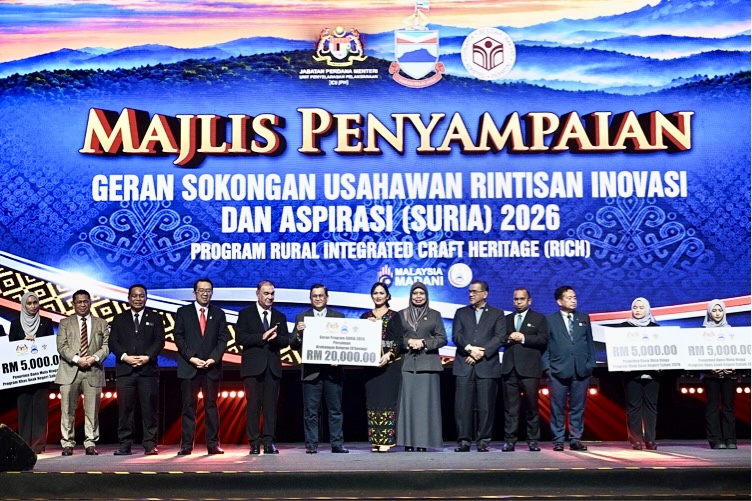
He said this at the Appreciation and Closing Ceremony of the Sabah Special Programme for Natives (PKAN) 2026 at the Sabah International Convention Centre (SICC) here today.
Local Government and Housing Minister Datuk Dr Haji Mohd Arifin Datuk Haji Mohd Arif delivered the speech. Hajiji, who is also Chairman of the Yayasan Sabah Board of Trustees, said human capital development must keep pace with changes in technology, employment and industry needs.
“The people of Sabah must be equipped with the knowledge and skills to adapt, innovate and seize opportunities. That is why education, training, guidance, entrepreneurship, and market access must complement one another so the skills acquired can translate into products, businesses, income, and community economic development.
“The Special Programme for Natives, or PKAN, which we are celebrating today, is an example of an initiative that provides opportunities for the people to build their capabilities through skills and experience. According to the Chief Minister, the participation of PKS batik and digital printing creations in the KPDN Presents: Fashion Forward Batik Malaysia fashion show during Kuala Lumpur Fashion Week 2026 showed that Sabah’s creativity and craftsmanship could gain wider recognition.
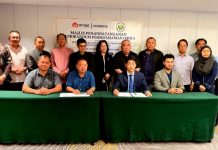
He said Yayasan Sabah’s continued efforts to ensure the handicraft industry’s sustainability and growth were also strengthened through the signing of a Memorandum of Understanding (MoU) between Yayasan Sabah, through PKS, and the Malaysian Timber Industry Board (MTIB).
This was followed by the presentation of Letters of Intention (LOI) to Yayasan Sabah from Kota Kinabalu Polytechnic, the All-Party Parliamentary Group Malaysia on Sustainable Development Goals (APPGM-SDG) and Sugee Group Sdn Bhd.
At the same time, Hajiji welcomed the involvement of educational institutions such as Yayasan Sabah College of Technology (KTYS) and University College Sabah Foundation (UCSF) in PKAN.
“Their involvement demonstrates that human capital development is not limited to traditional skills but also encompasses areas related to employability, technology, entrepreneurship and current industry needs.
“KTYS has also shown positive progress in its human capital development efforts. Between 2016 and 2026, KTYS implemented 93 programmes with a total allocation of RM15.01 million, involving 1,936 participants,” he said.
Through PKAN, KTYS implemented the Gerak Cemerlang SPM Programme (GeCerSPM), focusing on improving students’ performance in the critical subjects of Mathematics and Science.
Hajiji said the programme, which initially involved three schools and 200 students, improved the passing rate from 35 per cent to 98 per cent in the 2025 SPM examination.
Following its success, participation was expanded to 300 students from six schools this year, he said. I
n addition, the Gerak Ekonomi Makanan Inovasi Laut (GEMILAU) Programme was implemented to empower vulnerable communities economically through seafood processing skills, with 43 of the 89 participants successfully increasing their income, he said.
Meanwhile, UCSF, through PKAN Sabah 2026, implemented the Exploration and Empowerment of Technology, Arts and Entrepreneurship (EXPERTISE) programme, with an allocation of RM750,000 for 11 programmes benefiting 314 targeted participants comprising youths and Sabah’s native communities.
Hajiji said the Patient Care Assistant (PCA) Certificate Programme was among the initiatives implemented this year in collaboration with the Institut Jantung Negara University College (IJNUC), with 13 students securing three-month practical training placements at the National Heart Institute (IJN) and private clinics in Sabah.
He said the BRIDGE (Building Resources, Inclusivity, Development and Growth in Communities) programme had also been successfully implemented through nine programmes covering arts and crafts, tourism and hospitality, artificial intelligence (Al), science and technology, and agriculture.
The outreach programme involved 292 participants from districts and areas including Sipitang, Semporna, Pulau Banggi, Keningau, Ranau, Kota Belud, Kota Marudu and Kota Kinabatangan.
In this respect, UCSF has implemented 85 programmes with a total allocation of RM11.7 million, benefiting 1,842 participants between 2015 and 2025.
Hajiji assured that the State Government would continue to strengthen its efforts to ensure that Sabah’s development remained people-centred, with opportunities continuing to be made available to the people. -pr/BNN