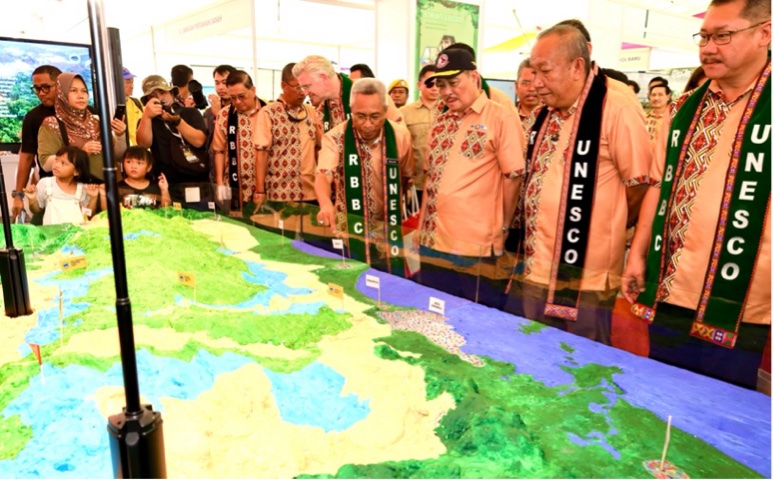
KOTA KINABALU: Chief Minister Datuk Seri Panglima Haji Hajiji Haji Noor said the proclamation of the Kinabatangan Biosphere Reserve, Sabah’s second after the Crocker Range Biosphere Reserve, marks a historic moment and a proud achievement for Sabah and Malaysia.
“The recognition by UNESCO last year proves that the Kinabatangan landscape, covering approximately 413,866 hectares, possesses outstanding biodiversity value and ecological significance at the international level.
“This is another important milestone in the State’s continuous efforts to preserve environmental sustainability and biodiversity on the global stage.
“With this world-class status, the Kinabatangan Biosphere Reserve is expected to attract international attention in the fields of research, education, nature-based tourism and global collaboration opportunities,” he said.
He said this at the 12th anniversary celebration of the Crocker Range Biosphere Reserve and the declaration ceremony of the Kinabatangan Biosphere Reserve at Padang Merdeka here on Sunday.
Hajiji said the value of the Crocker Range Biosphere Reserve, which spans 350,584 hectares and was declared in 2014, is of great importance to Sabah.
More than one million people are estimated to live in nearly 400 villages across 10 districts within the Crocker Range Biosphere Reserve, namely Tuaran, Kota Kinabalu, Penampang, Ranau, Tambunan, Keningau, Tenom, Beaufort, Papar and Membakut.
The recognition of the Crocker Range Biosphere Reserve has contributed to Sabah attaining the UNESCO Triple Crown Sites status.
As such, Hajiji called on all stakeholders to continue strengthening biodiversity conservation efforts, expanding community awareness programmes and enhancing strategic collaboration to ensure that the benefits of this recognition are widely and sustainably enjoyed.
“This is in line with the State Government’s commitment to protecting and conserving nature, as ecosystem functions are crucial for the well-being of the people and socio-economic development.
“The existence of these two biosphere reserves is also closely linked to the Sabah State Government’s efforts to realise the Sabah Maju Jaya initiative. This year, the conservation of Sabah’s important ecosystems continues under SMJ 2.0 for the 2026–2030 period,” he said.
The Chief Minister said Sabah is now at the forefront of environmental protection and conservation efforts.
“For many years, Sabah has protected its forests, wildlife and some of the richest ecosystems in the region. At present, nearly 30 per cent of Sabah’s land area has been gazetted as Totally Protected Areas (TPAs).
“We are therefore determined to further strengthen Sabah’s role as a carbon sink, including through the Crocker Range and Kinabatangan Biosphere Reserves.
“Sabah remains a major net carbon sink, contributing about 36 per cent of Malaysia’s total carbon sequestration through its vast tropical forests.
“The key message is that biosphere reserves support the climate, particularly by functioning as carbon sinks,” he said.
Hajiji said both biosphere reserves are special areas where nature is protected and human activities are managed sustainably.
“The Crocker Range Biosphere Reserve protects mountain and forest ecosystems to conserve unique flora and fauna while supporting water catchment functions.
“Meanwhile, the Kinabatangan Biosphere Reserve focuses on river and wetland ecosystems, which are important habitats for wildlife and essential for maintaining healthy water systems.
“When forests are protected and allowed to recover and regenerate naturally, they continue to store carbon over the long term,” he said.
He said biosphere reserves also play an important role in strengthening local economies and that conservation is most effective when communities benefit from efforts to protect nature.
“In the Crocker Range and Kinabatangan, local communities can benefit through sustainable tourism, including homestays and community-based enterprises.
“These long-term livelihood opportunities encourage communities to continue protecting forests and wildlife because the environment becomes a stable source of income rather than a source of short-term gains,” he said.
“Therefore, we must ensure that the recognition of these two biosphere reserves brings benefits and economic spillover effects to all segments of society living within both biosphere reserve areas,” he said.-pr/BNN